

CIRCADIAN® AUSTRALIA’s Mark and Jim were recently working in an ACRNA member’s control room on night shift delivering 24/7 shiftwork fatigue education and awareness to operators about the health benefits of mitigating circadian disruption.
They were asked if melatonin supplements would help achieve better sleep and discussions evolved about the pros and cons of melatonin supplements.
The 4 December 2025 publication of THE LIGHT DOCTOR NEWSLETTER, references scientifically validated research and information about Melatonin supplements.
The following extract from the newsletter should be of interest to all shift workers and anyone using or considering using Melatonin supplements.
THE LIGHT DOCTOR NEWSLETTER
Beware Melatonin Supplements:
Boost Your Natural Melatonin Instead
The Light Doctor Kindle book is available on Amazon.com.au
(Circadian Australia has no financial interest in the sale of this book on Amazon)
‘Insomniacs taking melatonin supplements are 3.5 times more likely to be hospitalized for heart failure, and nearly twice as likely to die from all causes. (Dr. Martin Moore-Ede Dec 3. 2025)
Melatonin is not “the sleep hormone” as is so often claimed. It does rise naturally during the hours of darkness, but at normal physiological levels it does not cause people to become sleepy¹. However, at the much higher non-natural pharmaceutical levels that are obtained by taking melatonin supplements, it can induce sleep.
Unlike most pharmaceutical medications, there have been very few controlled trials assessing the long-term health risks of melatonin supplements, and few regulations, because melatonin is regarded as a “natural substance.” The FDA does not require companies that sell melatonin pills to provide any evidence of their safety and efficacy.
Now there is evidence that long-term unnatural dosing with melatonin supplements may be dangerous, according to a recently released study from SUNY Downstate in Brooklyn, New York that was presented at the American Heart Association’s November 2025 meeting in New Orleans².
HOSPITALISATION FOR HEART FAILURE
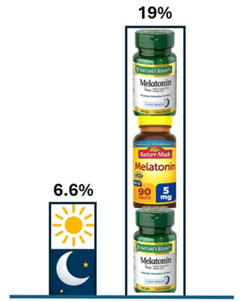
NATURAL. SUPPLEMENT.
People taking melatonin supplements for over a year are
3.5 times more likely to be hospitalized for heart failure..
The study involved 130,828 adults (average age of 55.7 years; 61.4% women) diagnosed with insomnia.
- 65,414 of the participants had been prescribed melatonin at least once and reported taking it for at least a year.
- Control group of 65,414 insomniacs not taking melatonin, who were matched to the group taking melatonin on 40 factors including demographics, health conditions and medications.
The Results
- Participants taking melatonin were nearly 3.5 times as likely to be hospitalized for heart failure when compared to those not taking melatonin (19.0% vs. 6.6%, respectively).
- Participants in the melatonin group were nearly twice as likely to die from any cause than those in the non-melatonin group (7.8% vs. 4.3%, respectively) over the 5-year period.
A Word of Caution
This is an associative study that by itself does not prove that melatonin supplements cause heart failure and death. However, it does trigger a warning to not assume that melatonin, because it is a “natural substance,” is safe. The dosages that people receive from supplements are much higher than natural circulating levels of melatonin in the human body.
Healthy Melatonin is Natural Melatonin
The best answer is to boost your natural levels of melatonin. This you can do by
- Regularly getting a good dose of outdoor sunlight in the morning. This will boost your natural production of melatonin at night.
- Sleeping in the dark at night (switching off all lights in the bedroom). This will prevent suppression of your natural melatonin peak
- Van den Heuvel, CJ., Kennaway DJ, and Dawson D. Effects of daytime melatonin infusion in young adults. Am. J. Physiol. 275 (Endocrinol. Metab. 38):E19–E26, 1998.
- Ekenedilichukwu Nnadi et al Effect of Long-term Melatonin Supplementation on Incidence of Heart Failure in Patients with Insomnia. Circulation 152, Suppl_3https://doi.org/10.1161/circ.152.suppl_3.4371606’
For more information about shiftwork related circadian disruption contact
mark@circadianaustralia.com.au jim@circadianaustralia.com.au