
CONTROL ROOM OF THE FUTURE
The Evidence Behind the Room’s Instincts
CSIRO and Monash University have released the full Stage 5 report behind the workshop ACRNA hosted at last year’s conference, and it confirms far more than one afternoon of post it notes.
ACRNA Marketing and Events | 27 July 2026
A quick recap
In October last year, Monash University researchers ran a workshop at the ACRNA conference, asking around 60 people from across the country’s control rooms to imagine the future together. We wrote about the result: a striking amount of agreement across sectors that had never compared notes before.
That workshop was one piece of a larger study. Monash, working with AEMO and CSIRO under the Australian Research in Power Systems Transition program, has now published the full Stage 5 report for Topic 3, Control Room of the Future, combining the ACRNA workshop with a detailed study inside AEMO’s own control rooms.
What the study actually did
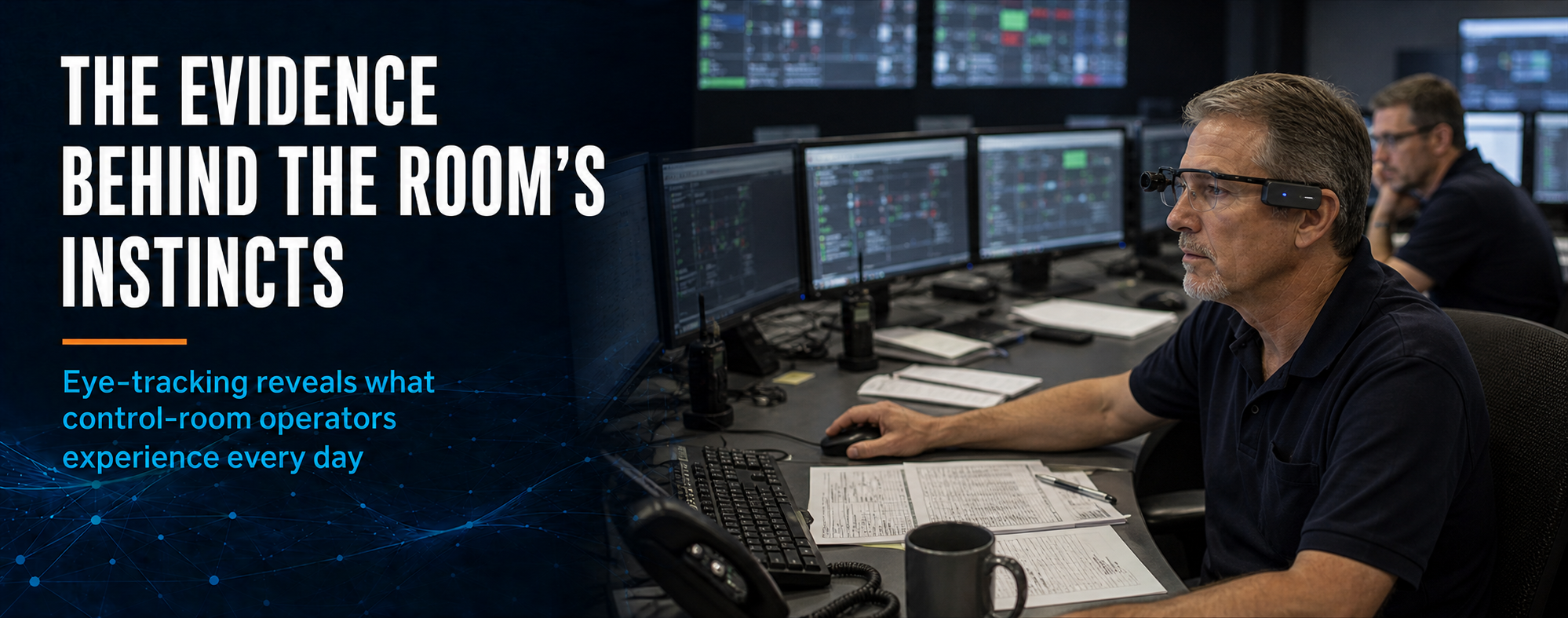
Before the workshops, the Monash team spent time inside AEMO’s National Electricity Market control room, fitting two operators with eye tracking glasses through three training scenarios of increasing complexity. This gave researchers a minute by minute picture of where operators look, which applications they use together, and how much manual effort it takes to move between them.
Alongside this, two workshops explored what a better future might look like: one run internally with AEMO staff, the other the ACRNA conference session, bringing people from electricity, gas, water, transport and emergency services into the same room. Bringing an outside, cross sector view into a study built mainly around one organisation was a deliberate step to test whether the findings held beyond AEMO.
Seven problems, five principles
What operators are dealing with now
- Every operator sets up their screens differently, shaped by role, experience and habit.
- Applications look and behave inconsistently with each other, which adds to visual effort.
- Operators switch between applications constantly, often with several open at once.
- Manual effort slows decisions down, because there is limited automation to lean on.
- Sharing situational awareness with colleagues has no dedicated digital tools, so it relies on conversation and notes.
- Systems are disconnected, with no single, centralised view of an event.
- Training environments do not fully match the live control room, so lessons do not always carry across.
What a better future looks like
- Flexible yet consistent: interfaces that adapt to the person and the task, without losing a shared, familiar structure.
- Zero click to critical: the system surfaces what matters, rather than making operators hunt for it.
- One model, many views: a single, consistent data model feeding every screen.
- Automate the known: where the facts are certain, automate by default, and let people step in when it matters.
- Rapid explainable suggestions: AI recommendations paired with a clear, human readable reason, so operators can trust and question them.
Where the room and the data lined up
What stands out in the full report is how closely the ACRNA workshop’s findings echo the data gathered inside AEMO. The desire for a single operational picture, the most common wish in the room, is also the strongest signal in the report, raised independently by ten workshop groups and reinforced by eye tracking data showing constant, effortful switching between applications. The wish for better presented, not just more, data was nearly as strong, raised by nine groups.
The same pattern holds for automation and prediction. AI assisted decisions and predictive, what if style tools were each raised by nine groups, and training and simulation by eight. Less common ideas, like voice control, immersive VR and operator wellbeing, appear as genuine, early stage directions rather than one off suggestions.
Eleven recommendations, three groups
The report translates this into eleven recommendations across three groups. Visualisation and Interaction covers the basics of a calmer screen: consistent colours and layouts, easier interactions, and switchable operator profiles. Unified Context Aware Systems groups the applications operators already use together into coherent workspaces, moving toward one centralised view for managing an event start to finish. Integrated Context Aware Solutions is where AI enters directly, always paired with a plain language explanation, and extends into the single line diagram operators rely on most.
An eleventh, interim recommendation calls for the rapid creation of standardised dashboards, a practical stopgap while the larger systems work catches up.
Twenty five guidelines for cleaner screens
The report closes with 25 guidelines for control room visualisation and dashboard design, covering layout, typography, colour and how AI generated suggestions should be explained on screen. Examples include consistently aligned labels and columns, limiting how many colours carry meaning at once, avoiding scrolling on primary operational views, and using colour combinations that remain readable for people with colour vision deficiency, a group that includes around 8 percent of Australian men. These are grounded in what the eye tracking data showed was actually slowing operators down.
Read the full report
The full Stage 5 report, Topic 3: Control Room of the Future, is now published by CSIRO and worth reading in full. It sets out all seven pain points, five design principles, eleven recommendations and twenty five guidelines, alongside the eye tracking analysis behind them.
Thank you to Monash University, AEMO and CSIRO for continuing to draw on ACRNA’s network in this research, and to everyone who took part in last year’s workshop. The next step is deciding, together, which parts of this shared picture to bring to life first.