
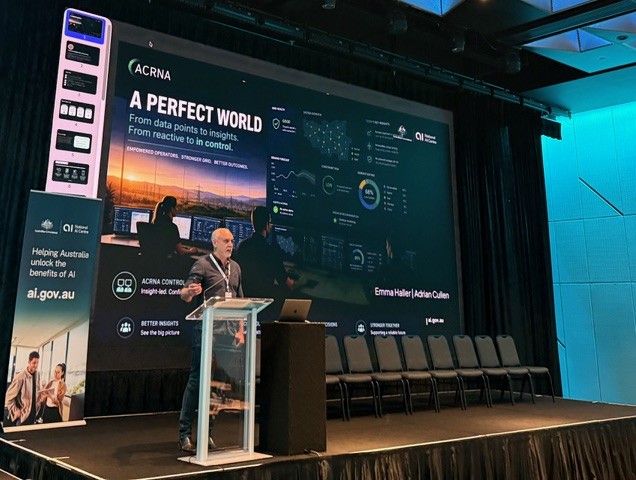
Sam Mackenzie, ACRNA Vice President
ACRNA Conference 2026, Brisbane, a roundup of the Day Two workshop
The final session of the ACRNA 2026 conference was always going to be the hardest sell. Two and a half hours, late on the second afternoon, on the one topic guaranteed to divide a room of operational professionals. Adrian Cullen and Emma Haller from the National Artificial Intelligence Centre ran “AI in the Control Room, Beyond the Hype”, and by the close of the day the room had done something more useful than debate the technology. It had designed its own.
Trust was earned before the first slide
Adrian opened by telling the room that in preparation for the session he had visited three control rooms — real visits around Brisbane, talking with operators about the challenges they face.
It was an effective way to shift the temperature in the room — from “this is going to take our jobs” to “how could we actually use it” — in the space of two sentences. Delegates who arrived braced for a generic AI pitch instead heard someone describe the environment they actually work in, and describe it accurately. His conclusion was equally direct. The work performed in a control room is genuinely complex, and the people doing it are not about to be replaced.
The pre-work mattered more than the content that followed it. Credibility with operational staff has never been built on the best slide deck; it comes from showing up.
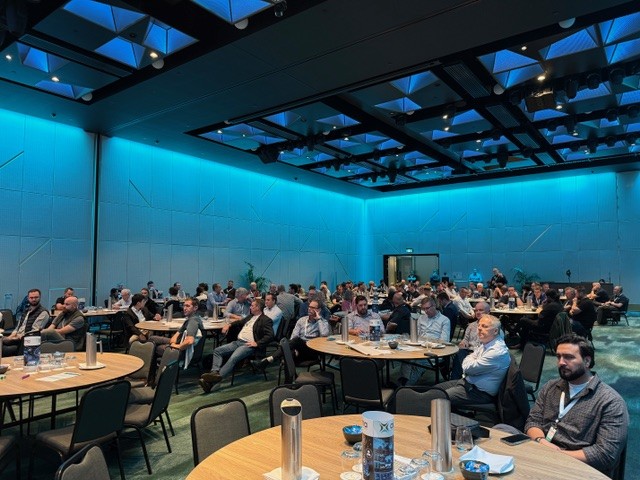
The room did the work
Emma Haller took the facilitation from there and held a difficult slot, keeping the energy up and every table on the task in front of it. Tables chose a real control room problem, worked it through as a group, and finished by designing and pitching an AI agent of their own, with the safeguards named and the human decision points made explicit.
The valuable output was not any single concept. It was the shift in framing that happened once people started talking to each other.
AI stopped being a nebulous external force arriving to take control room jobs. It became a set of creative options applied to a business challenge the table had chosen for itself. Delegates moved from defending their roles to designing around their own frustrations.
That was the real gold in the session and worth noting for anyone responsible for AI adoption in an operational business. Resistance is usually treated as a change management problem to be solved with communication. The workshop suggests something simpler. People resist solutions handed to them and engage with problems they have named themselves.
While the votes for best idea were counted, Michael Mackenzie and Matthew Wikman of the Australian Energy Market Operator (AEMO) presented what they have been piloting: an AI alert management system built to cut through alarm noise to streamline first pass triage. Many control room asset operators struggle with the sheer number of alarms coming through and with triaging them efficiently. The stated aim of the pilot is not autonomous operation. It is supporting operator judgement while reducing the monitoring load.
Not all AI sits at the same distance from the desk
The most useful idea to come out of the afternoon was that AI in a control room is not one decision. It is several, and they are best separated by how close the technology sits to live operational control.
- Training. Scenario generation and rehearsal of abnormal events. Nothing touches a live operation, so the cost of being wrong is low.
- Knowledge capture. Holding incidents, decisions and reasoning so operational experience survives retirements and team changes.
- Analysis. Post-event review and pattern detection, with a person interpreting the output before anything is acted on.
- Triage and recommendation. The first level that touches the live shift. The system prioritises and explains, the operator still decides and still acts.
- Automation in the control loop itself. The system acts on its own. The consensus in the room is that this won’t be suitable for control room operations until AI behaviour is deterministic (maybe never), meaning the same inputs produce the same output every time and the reasoning can be reconstructed afterwards.
The first four are available now with manageable risk. The fifth is not. Organisations that treat AI as a single go or no-go decision tend to stall on the hardest version of the question, while those that work up the levels get operational value while the assurance case for anything further is still being built.
Three things to take away
Start with the human problem. Solutions designed around a defined operator problem are easier to scope, easier to justify and easier to adopt than solutions looking for a home.
Cognitive load is the near-term opportunity. Alarm rationalisation, situational awareness, shift handover and captured operational memory came up repeatedly, across sectors and across tables. Unglamorous problems, measurable operational value.
Design the safeguards in from the start. Name what stays with the human before the pilot, not after it. That discipline is what keeps a triage tool from quietly becoming an automation one.
The workshop closed the 2026 conference on the theme it opened with. Resilience in the control room is a human capability, and technology earns its place by supporting the people who deliver it.